
Yi Wi Jong
Read the text version
The Lost Love Letters of Prince Tiyong of Korea (1898–1907)
Mayfair Stamps · February 1, 2023
Read the text version
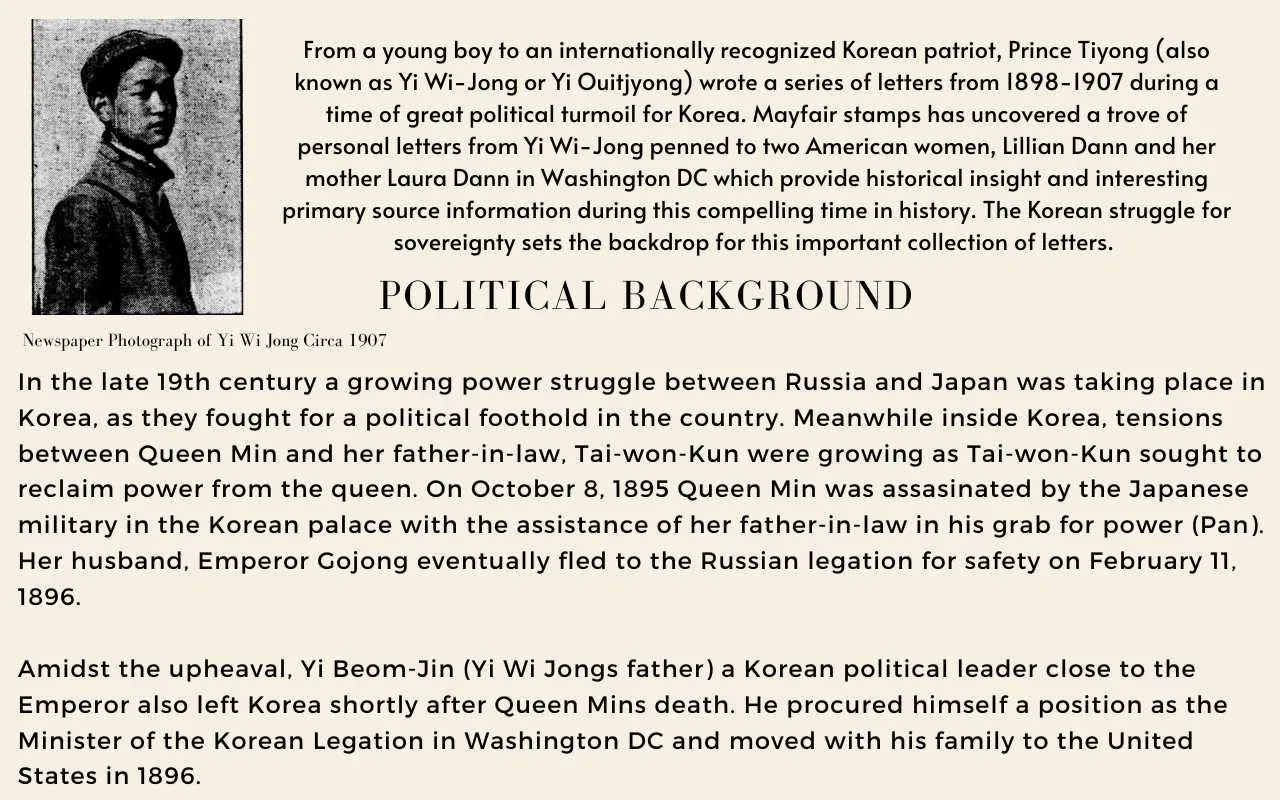
From a young boy to an internationally recognized Korean patriot, Prince Tiyong (also known as Yi Wi-Jong or Yi Ouitjyong) wrote a series of letters from 1898–1907 during a time of great political turmoil for Korea. Mayfair Stamps has uncovered a trove of personal letters from Yi Wi-Jong penned to two American women, Lillian Dann and her mother Laura Dann in Washington DC, which provide historical insight and interesting primary source information during this compelling time in history. The Korean struggle for sovereignty sets the backdrop for this important collection of letters.
Newspaper photograph of Yi Wi Jong, circa 1907.
Political background
In the late 19th century a growing power struggle between Russia and Japan was taking place in Korea, as they fought for a political foothold in the country. Meanwhile inside Korea, tensions between Queen Min and her father-in-law, Tai-won-Kun, were growing as Tai-won-Kun sought to reclaim power from the queen. On October 8, 1895 Queen Min was assassinated by the Japanese military in the Korean palace with the assistance of her father-in-law in his grab for power (Pan). Her husband, Emperor Gojong, eventually fled to the Russian legation for safety on February 11, 1896.
Amidst the upheaval, Yi Beom-Jin (Yi Wi Jong's father), a Korean political leader close to the Emperor, also left Korea shortly after Queen Min's death. He procured himself a position as the Minister of the Korean Legation in Washington DC and moved with his family to the United States in 1896.
Read the text version
Life in the United States
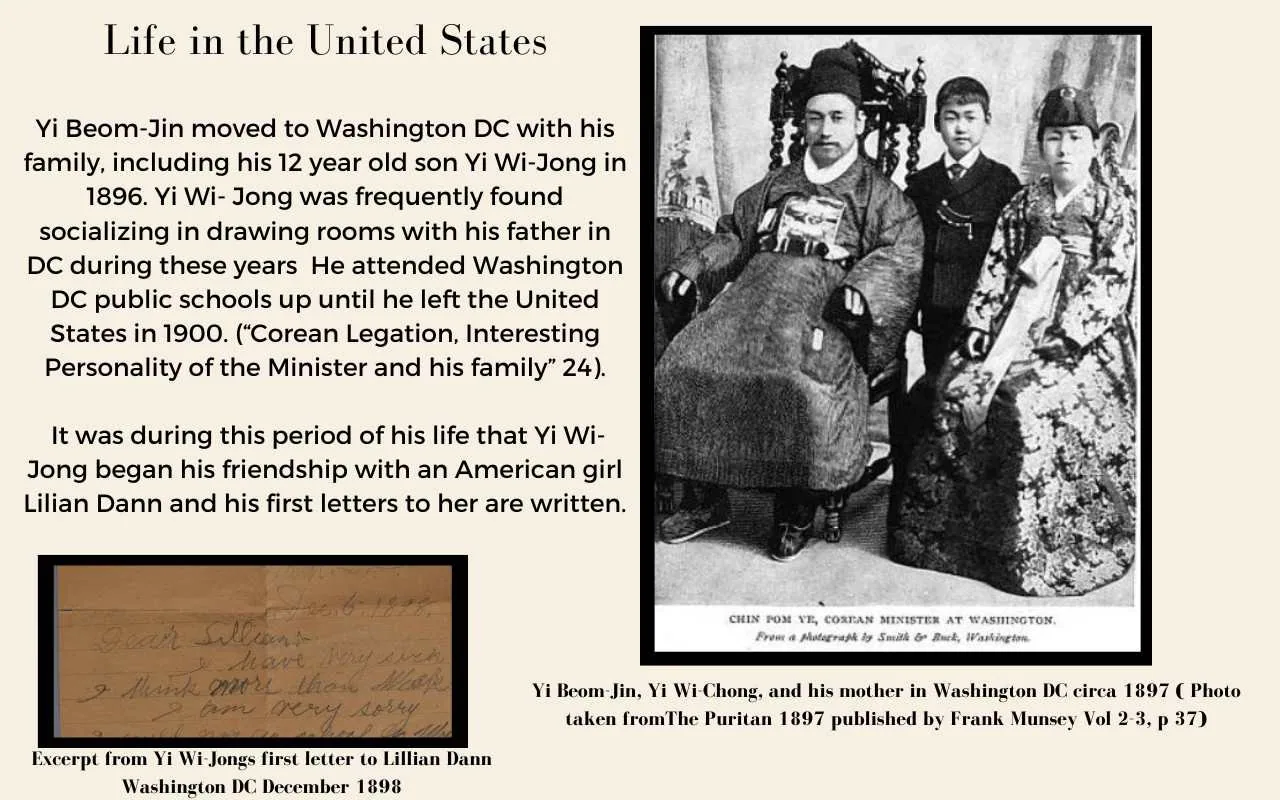
Yi Beom-Jin moved to Washington DC with his family, including his 12 year old son Yi Wi-Jong, in 1896. Yi Wi-Jong was frequently found socializing in drawing rooms with his father in DC during these years. He attended Washington DC public schools up until he left the United States in 1900 (“Corean Legation, Interesting Personality of the Minister and his Family” 24).
It was during this period of his life that Yi Wi-Jong began his friendship with an American girl, Lillian Dann, and his first letters to her are written.
Excerpt from Yi Wi-Jong's first letter to Lillian Dann, Washington DC, December 1898. Photo: Yi Beom-Jin, Yi Wi-Chong, and his mother in Washington DC circa 1897 (from The Puritan, 1897, published by Frank Munsey, Vol. 2-3, p. 37).
Read the text version
Laura & Lillian Dann
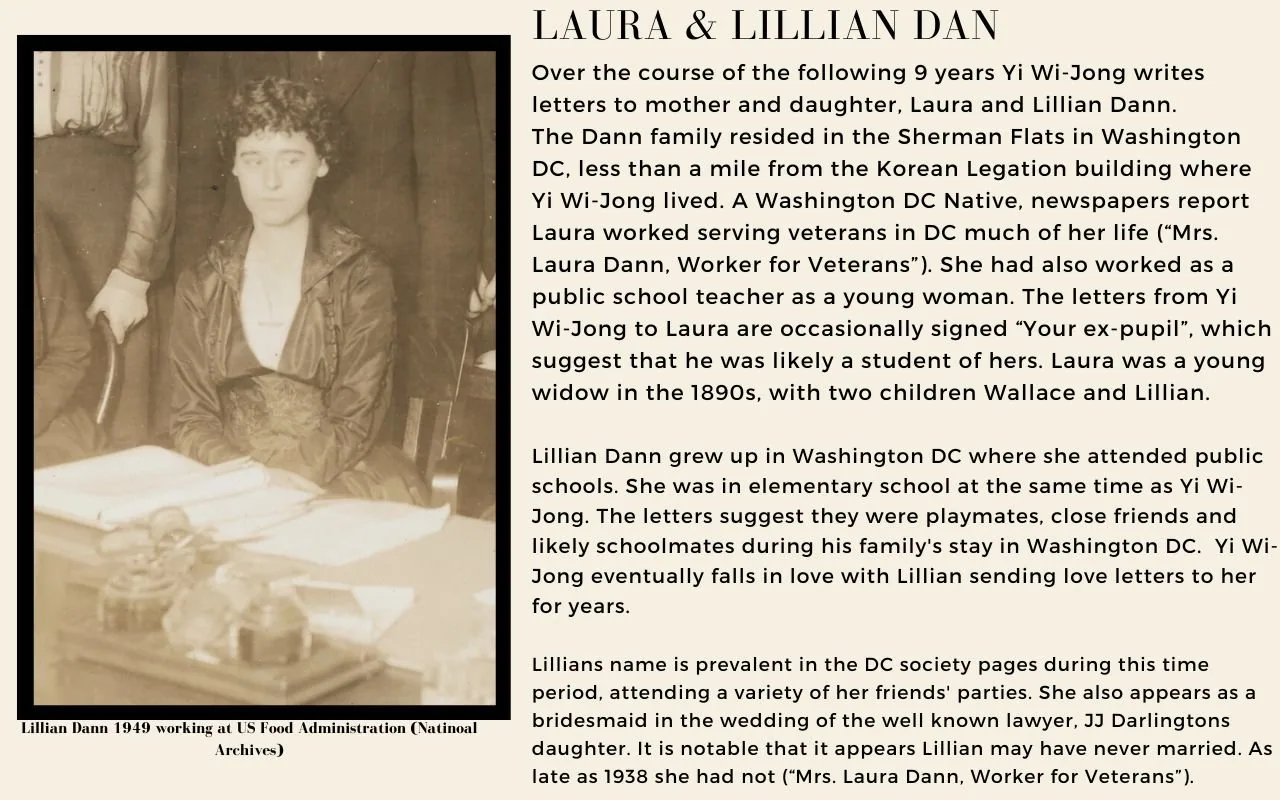
Over the course of the following 9 years Yi Wi-Jong writes letters to mother and daughter, Laura and Lillian Dann. The Dann family resided in the Sherman Flats in Washington DC, less than a mile from the Korean Legation building where Yi Wi-Jong lived. A Washington DC native, newspapers report Laura worked serving veterans in DC much of her life (“Mrs. Laura Dann, Worker for Veterans”). She had also worked as a public school teacher as a young woman. The letters from Yi Wi-Jong to Laura are occasionally signed “Your ex-pupil”, which suggest that he was likely a student of hers. Laura was a young widow in the 1890s, with two children, Wallace and Lillian.
Lillian Dann grew up in Washington DC where she attended public schools. She was in elementary school at the same time as Yi Wi-Jong. The letters suggest they were playmates, close friends and likely schoolmates during his family's stay in Washington DC. Yi Wi-Jong eventually falls in love with Lillian, sending love letters to her for years.
Lillian's name is prevalent in the DC society pages during this time period, attending a variety of her friends' parties. She also appears as a bridesmaid in the wedding of the well known lawyer JJ Darlington's daughter. It is notable that it appears Lillian may have never married. As late as 1938 she had not (“Mrs. Laura Dann, Worker for Veterans”).
Lillian Dann, 1949, working at the US Food Administration (National Archives).
Read the text version
Yi Wi-Jong's life in France
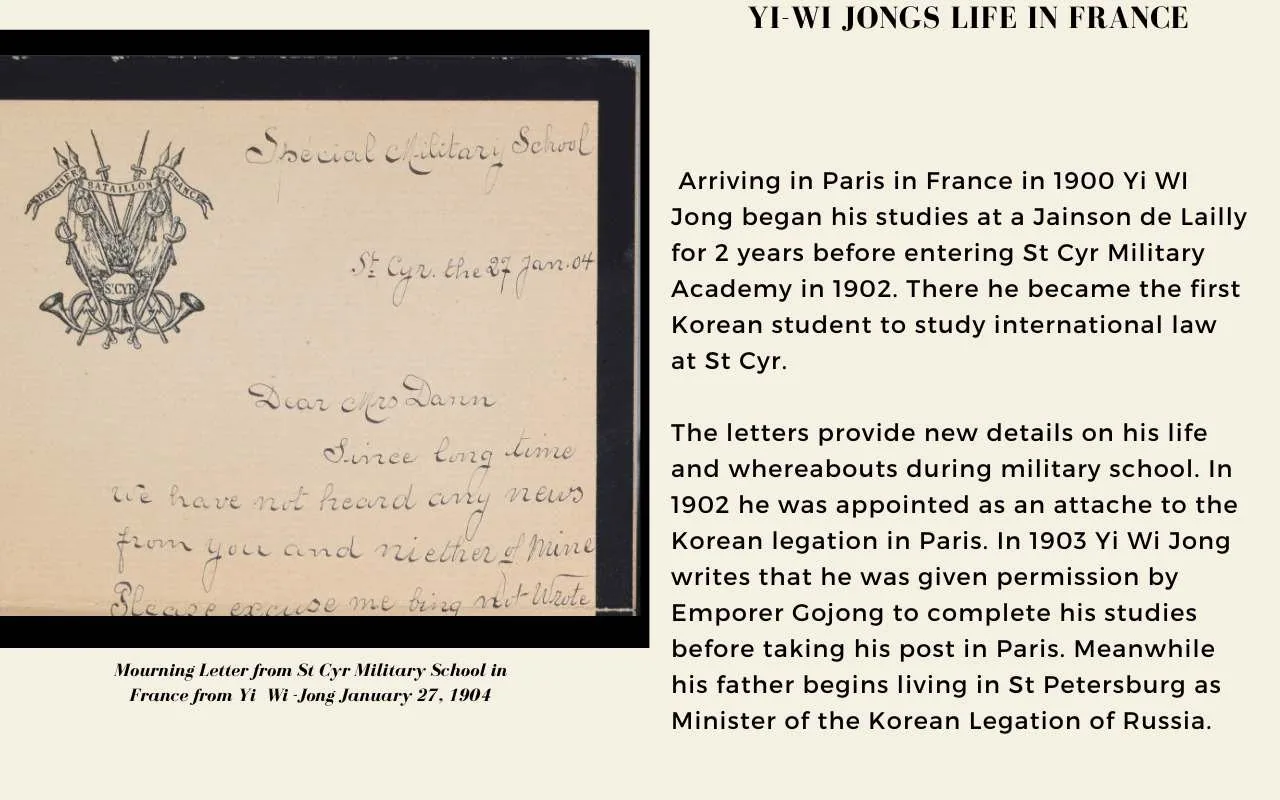
Arriving in Paris, France in 1900, Yi Wi Jong began his studies at Jainson de Sailly for 2 years before entering St Cyr Military Academy in 1902. There he became the first Korean student to study international law at St Cyr.
The letters provide new details on his life and whereabouts during military school. In 1902 he was appointed as an attaché to the Korean legation in Paris. In 1903 Yi Wi Jong writes that he was given permission by Emperor Gojong to complete his studies before taking his post in Paris. Meanwhile his father begins living in St Petersburg as Minister of the Korean Legation of Russia.
Mourning letter from St Cyr Military School in France from Yi Wi-Jong, January 27, 1904.
Read the text version
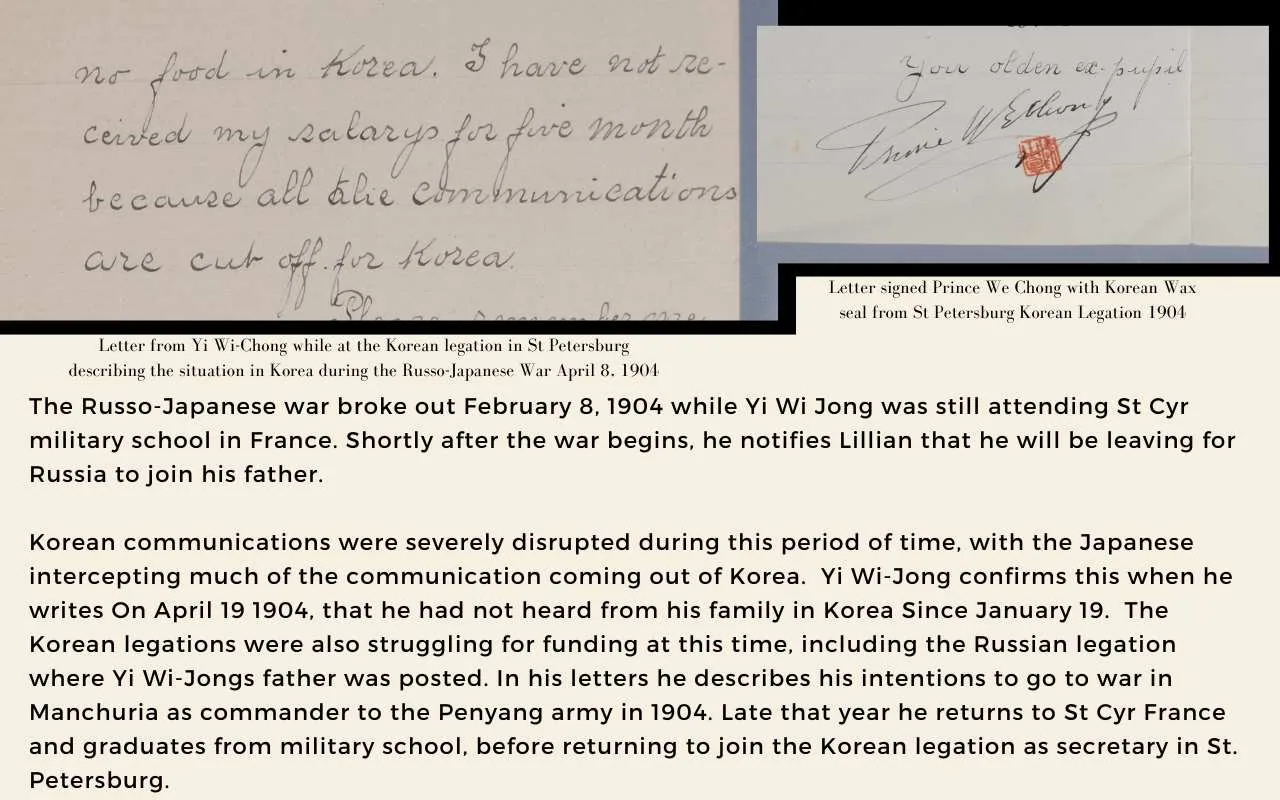
Letter from Yi Wi-Chong while at the Korean legation in St Petersburg describing the situation in Korea during the Russo-Japanese War, April 8, 1904. Letter signed “Prince We Chong” with Korean wax seal from the St Petersburg Korean Legation, 1904.
The Russo-Japanese war broke out February 8, 1904 while Yi Wi Jong was still attending St Cyr military school in France. Shortly after the war begins, he notifies Lillian that he will be leaving for Russia to join his father.
Korean communications were severely disrupted during this period of time, with the Japanese intercepting much of the communication coming out of Korea. Yi Wi-Jong confirms this when he writes on April 19, 1904 that he had not heard from his family in Korea since January 19. The Korean legations were also struggling for funding at this time, including the Russian legation where Yi Wi-Jong's father was posted. In his letters he describes his intentions to go to war in Manchuria as commander to the Penyang army in 1904. Late that year he returns to St Cyr, France and graduates from military school, before returning to join the Korean legation as secretary in St. Petersburg.
Read the text version
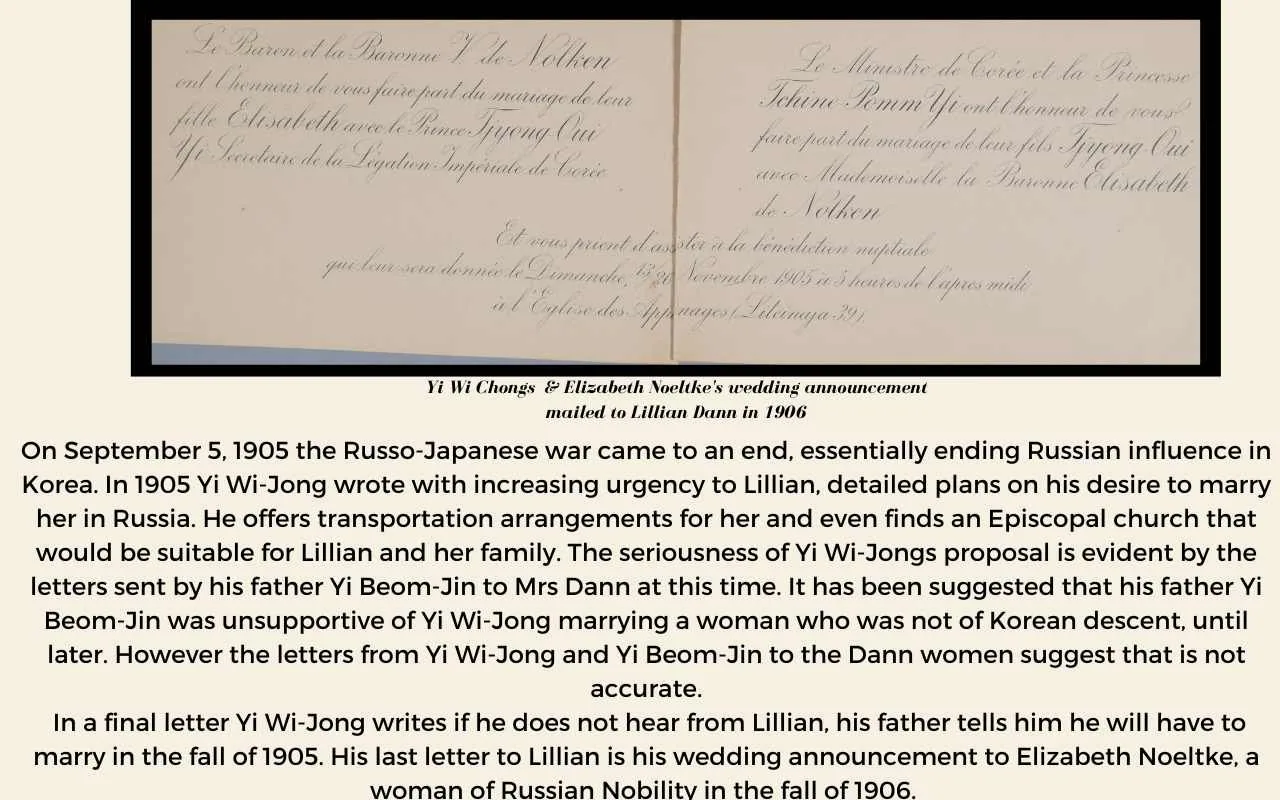
Yi Wi Chong & Elizabeth Noeltke's wedding announcement, mailed to Lillian Dann in 1906.
On September 5, 1905 the Russo-Japanese war came to an end, essentially ending Russian influence in Korea. In 1905 Yi Wi-Jong wrote with increasing urgency to Lillian, detailing plans on his desire to marry her in Russia. He offers transportation arrangements for her and even finds an Episcopal church that would be suitable for Lillian and her family. The seriousness of Yi Wi-Jong's proposal is evident by the letters sent by his father Yi Beom-Jin to Mrs Dann at this time. It has been suggested that his father Yi Beom-Jin was unsupportive of Yi Wi-Jong marrying a woman who was not of Korean descent, until later. However the letters from Yi Wi-Jong and Yi Beom-Jin to the Dann women suggest that is not accurate.
In a final letter Yi Wi-Jong writes that if he does not hear from Lillian, his father tells him he will have to marry in the fall of 1905. His last letter to Lillian is his wedding announcement to Elizabeth Noeltke, a woman of Russian nobility, in the fall of 1906.
Read the text version
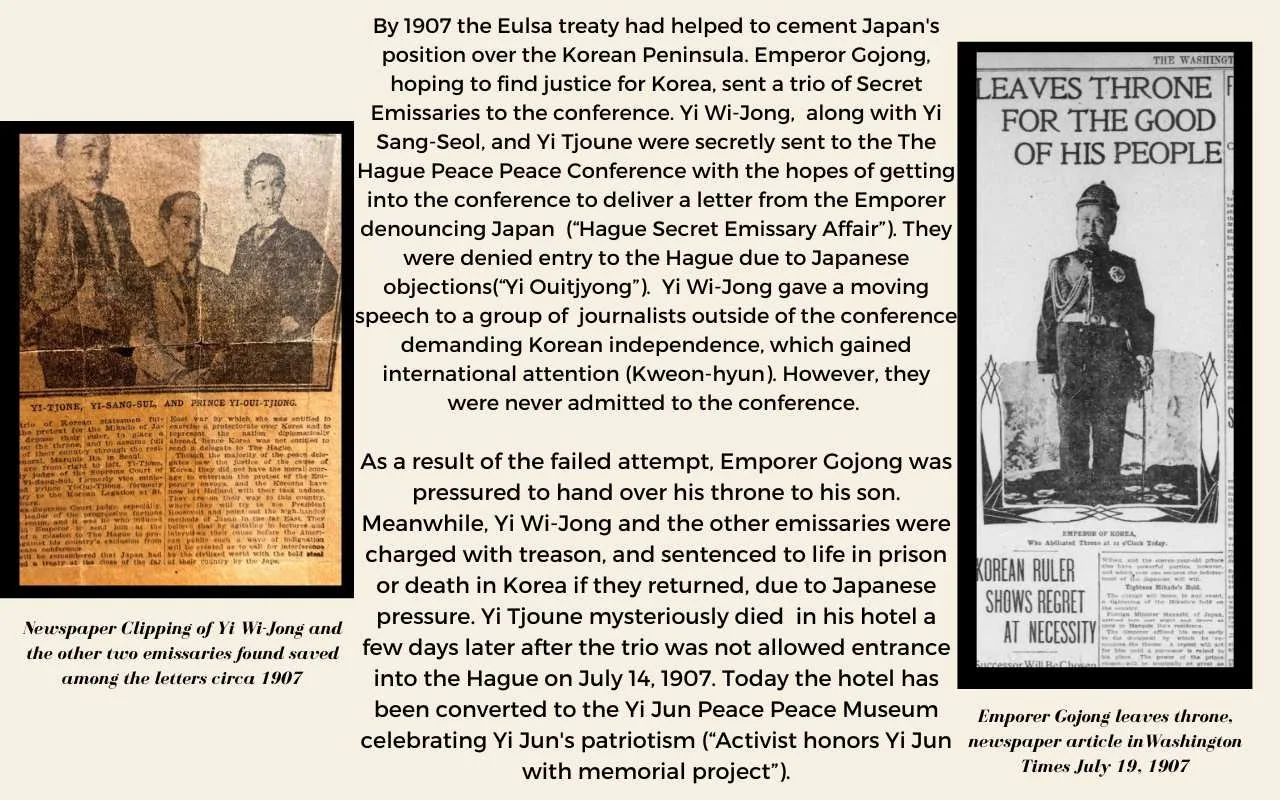
By 1907 the Eulsa treaty had helped to cement Japan's position over the Korean Peninsula. Emperor Gojong, hoping to find justice for Korea, sent a trio of secret emissaries to the conference. Yi Wi-Jong, along with Yi Sang-Seol and Yi Tjoune, were secretly sent to the Hague Peace Conference with the hopes of getting into the conference to deliver a letter from the Emperor denouncing Japan (“Hague Secret Emissary Affair”). They were denied entry to the Hague due to Japanese objections (“Yi Ouitjyong”). Yi Wi-Jong gave a moving speech to a group of journalists outside of the conference demanding Korean independence, which gained international attention (Kweon-hyun). However, they were never admitted to the conference.
As a result of the failed attempt, Emperor Gojong was pressured to hand over his throne to his son. Meanwhile, Yi Wi-Jong and the other emissaries were charged with treason, and sentenced to life in prison or death in Korea if they returned, due to Japanese pressure. Yi Tjoune mysteriously died in his hotel a few days later after the trio was not allowed entrance into the Hague on July 14, 1907. Today the hotel has been converted to the Yi Jun Peace Museum celebrating Yi Jun's patriotism (“Activist honors Yi Jun with memorial project”).
Newspaper clipping of Yi Wi-Jong and the other two emissaries found saved among the letters, circa 1907. “Emperor Gojong leaves throne,” newspaper article in the Washington Times, July 19, 1907.
Read the text version
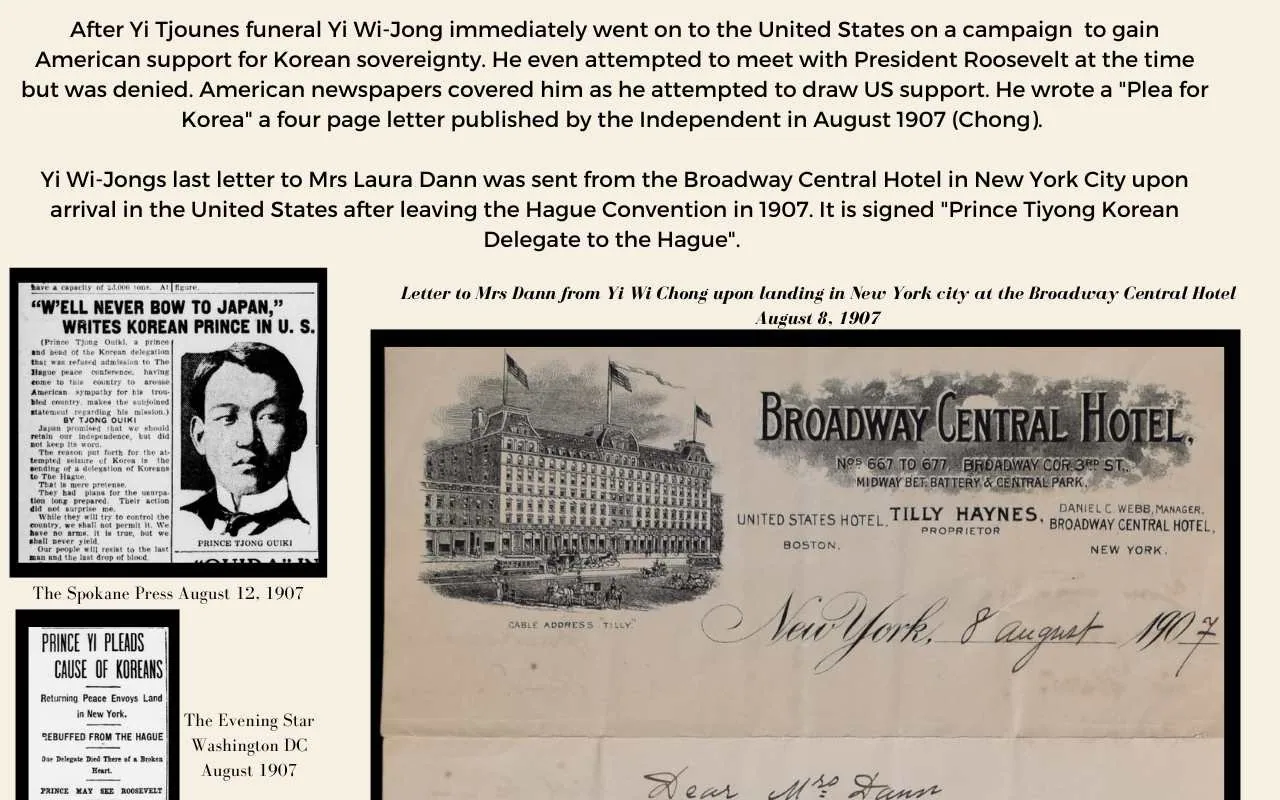
After Yi Tjoune's funeral Yi Wi-Jong immediately went on to the United States on a campaign to gain American support for Korean sovereignty. He even attempted to meet with President Roosevelt at the time but was denied. American newspapers covered him as he attempted to draw US support. He wrote a “Plea for Korea”, a four page letter published by the Independent in August 1907 (Chong).
Yi Wi-Jong's last letter to Mrs Laura Dann was sent from the Broadway Central Hotel in New York City upon arrival in the United States after leaving the Hague Convention in 1907. It is signed “Prince Tiyong Korean Delegate to the Hague”.
“We'll never bow to Japan,” writes Korean prince in U.S. — The Spokane Press, August 12, 1907. “Prince Yi pleads cause of Koreans” — The Evening Star, Washington DC, August 1907. Letter to Mrs Dann from Yi Wi Chong upon landing in New York City at the Broadway Central Hotel, August 8, 1907.
Read the text version
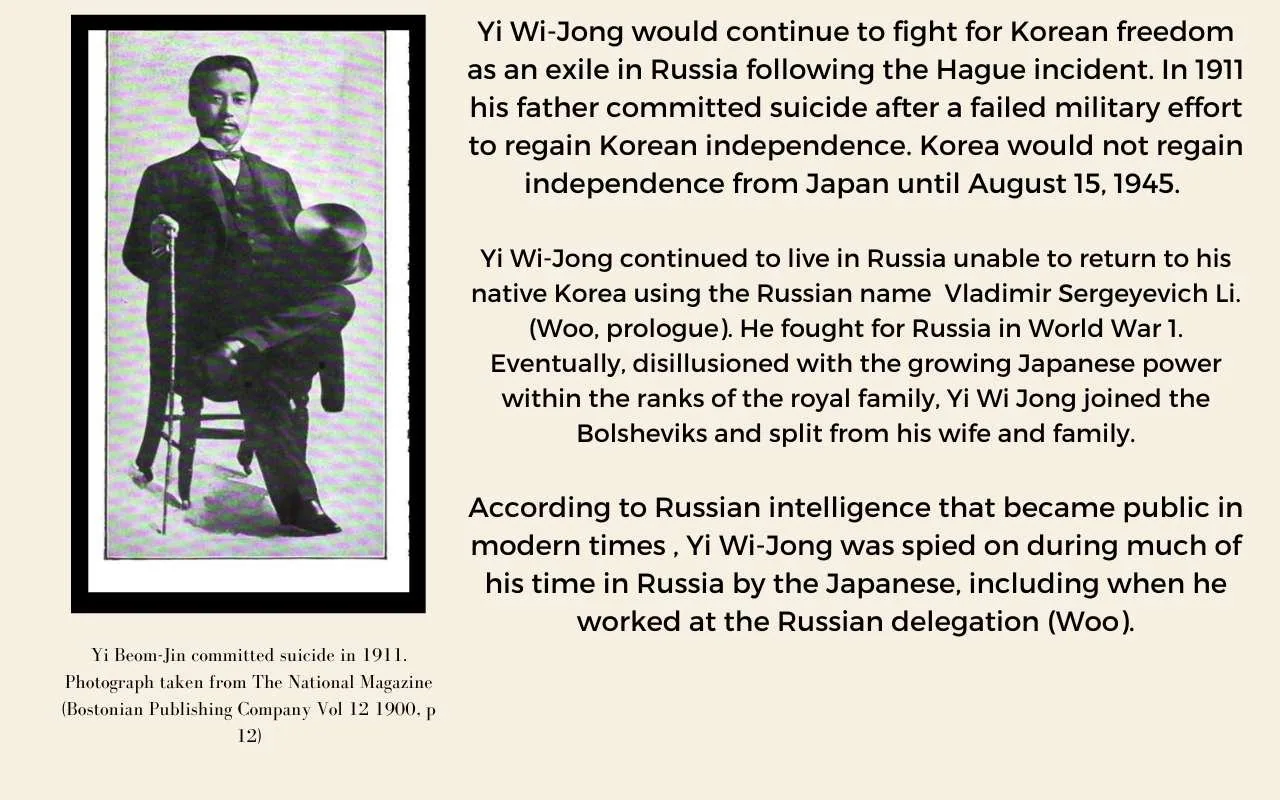
Yi Wi-Jong would continue to fight for Korean freedom as an exile in Russia following the Hague incident. In 1911 his father committed suicide after a failed military effort to regain Korean independence. Korea would not regain independence from Japan until August 15, 1945.
Yi Wi-Jong continued to live in Russia unable to return to his native Korea, using the Russian name Vladimir Sergeyevich Li (Woo, prologue). He fought for Russia in World War I. Eventually, disillusioned with the growing Japanese power within the ranks of the royal family, Yi Wi Jong joined the Bolsheviks and split from his wife and family.
According to Russian intelligence that became public in modern times, Yi Wi-Jong was spied on during much of his time in Russia by the Japanese, including when he worked at the Russian delegation (Woo).
Yi Beom-Jin died in 1911. Photograph taken from The National Magazine (Bostonian Publishing Company, Vol. 12, 1900, p. 12).
Read the text version
Yi Wi-Jong's courage and life long struggle for Korea has secured his place in history as a Korean patriot and freedom fighter. The discovery of these letters written at such a defining time in Korean history makes them interesting for historians, postal history, and cover collectors.
The tidbits discussed here only begin to scratch the surface of the content and stories in this collection of letters. When we began our research into the history of Yi Wi-Jong we did not expect to find such a fascinating back story and to uncover such an important figure in Korean history.
This important collection will be available for sale from Mayfair Stamps. We are now accepting offers. Serious inquiries only please. Please contact us for information.
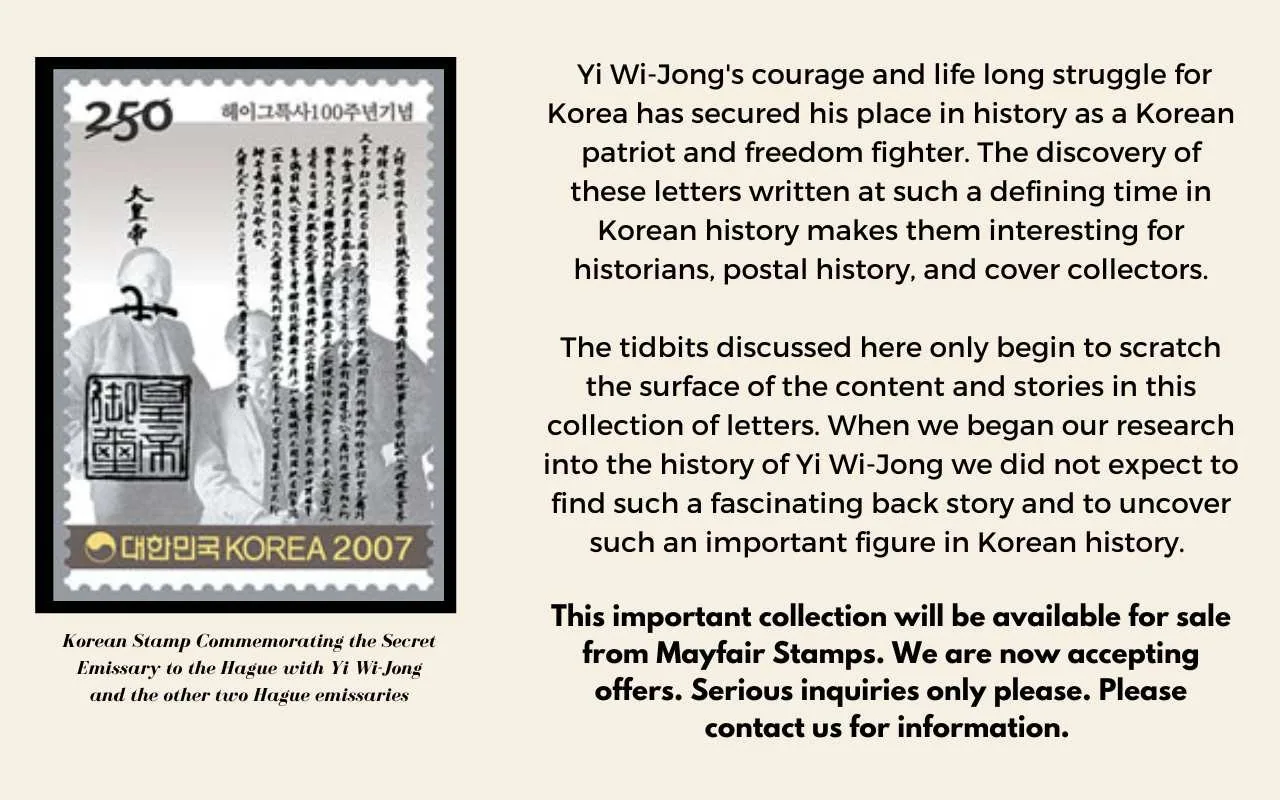
Korean stamp commemorating the Secret Emissary to the Hague with Yi Wi-Jong and the other two Hague emissaries.